


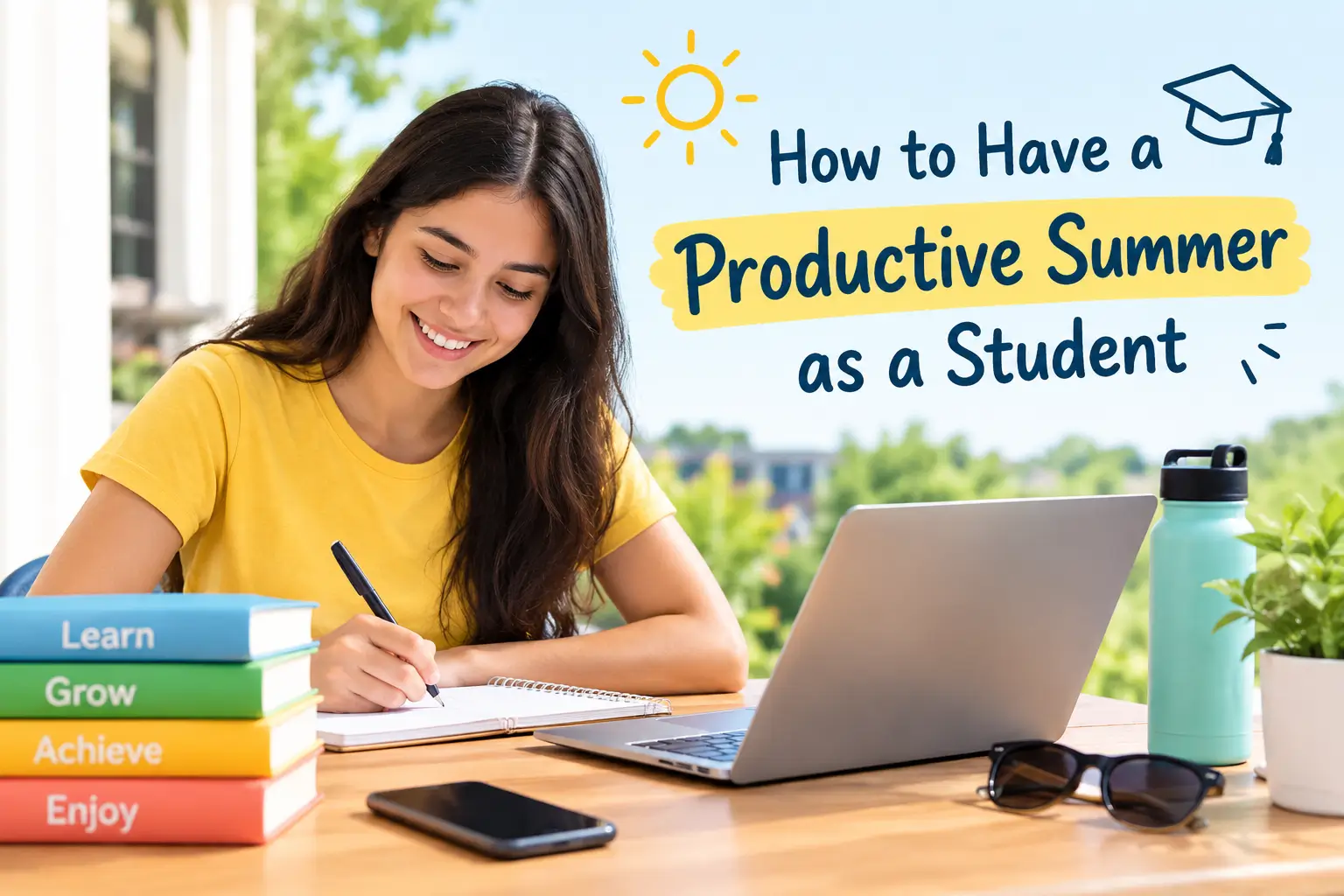
Summer break gives students something they often wish they had during the school year: more free time. There are no early classes, daily homework, or tests waiting around the corner. But after a few weeks, having too much free time can also become boring.
A productive summer does not mean studying from morning to night. You should still relax, spend time with friends and family, enjoy hobbies, and have fun. The goal is to use some of your free time in a way that helps you feel better, learn something useful, or prepare for your future.
Whether you are a high school student, in college, or getting ready for your next academic year, a few simple habits can make your summer more meaningful.
What Does a Productive Summer Look Like?
A productive summer can look different for every student. One student may get a summer job. Another may learn how to cook. Someone else may take an online class, volunteer in the community, read books, or work on a personal project. You do not need to fill every hour of your day with activities. In fact, too much planning can make your summer feel like another school term. A good summer usually includes a mix of learning, personal growth, work, health, social time, and rest.
1. Set a Few Summer Goals
Before summer gets busy, think about what you would like to accomplish. Students do not need a long list of goals. Pick two or three things that matter to you. For example, you might want to improve your writing, learn basic cooking, save some money, exercise regularly, or prepare for college applications. Put your goals where you can see them every day. Then break each goal into small steps. If your goal is to read six books during summer, you could read a few pages each day instead of trying to finish an entire book in one weekend.
Avoid creating a schedule that looks perfect on paper but becomes impossible to follow. If you already know that you enjoy sleeping late during summer, do not suddenly plan to wake up at 5 a.m. every day unless you have a real reason to do it.
2. Learn a Useful Skill
Summer gives students time to learn something outside their regular school subjects. Think about a skill that could help you in everyday life or your future career. Students could learn basic computer skills, photography, public speaking, cooking, budgeting, graphic design, writing, coding, or another skill that interests you.
You do not need to become an expert. The goal is to understand the basics and practice regularly. For example, a student interested in business could learn how to create a simple budget. Someone interested in photography could practice taking better pictures with a phone or camera. The important thing is to choose something you genuinely want to learn.
3. Read for Fun and Learning
Reading is one of the easiest ways to make your summer productive. You do not have to read only textbooks or school-related books. Choose subjects that interest you. You could read novels, biographies, history books, personal finance books, science books, or books about careers you are considering. If reading an entire book feels difficult, start with 10 or 15 minutes a day. Reading often can also help you grow your vocabulary, improve your writing, build better understanding, and boost your focus.
4. Consider a Summer Job
For older students, a summer job can provide valuable experience. You can earn money while learning how a workplace operates. Depending on your age and local rules, you may find opportunities in retail, restaurants, recreation programs, camps, customer service, or other seasonal work.
A summer job can teach lessons that you may not learn in a classroom. You may learn how to communicate with customers, work with a team, manage your time, follow instructions, and handle responsibility. If you earn money, consider saving part of it instead of spending everything immediately.
Summer can also be a good time to develop simple financial habits. Track how much money you receive and how much you spend. Set aside some money for savings before spending on entertainment. You do not need a complicated financial plan. Even learning how to create and follow a simple budget can give you a useful skill for adulthood.
5. Work on Your Health
Students’ physical and mental health can change how you feel and how well you do when school starts back up. Summer gives you more flexibility to build healthy habits. You could walk, ride a bike, swim, play a sport, go to the gym, or simply spend more time outside.
You also have an opportunity to improve your sleep schedule. Try to get enough sleep instead of staying awake every night because you do not have school the next morning. Healthy habits do not need to feel extreme. Small changes that you can continue are often easier to maintain.
6. Spend Less Time on Your Phone
Phones, games, streaming services, and social media can easily consume several hours without you noticing. You do not need to stop using your phone completely. Instead, become more aware of how you spend your screen time.
Try putting your phone away while reading, exercising, eating with your family, or working on an important task. You may discover that you have more free time than you thought.
Choose one part of your day when you stay away from unnecessary screen use. For example, you could spend the first 30 minutes after waking up without checking social media. A small rule can make it easier to control your screen time without making your summer feel restrictive.
7. Volunteer in Your Community
Volunteering can make your summer more meaningful while helping other people. Look for opportunities through community organizations, libraries, schools, animal shelters, food banks, local events, or other organizations that accept student volunteers.
Volunteering can also help you understand different types of work and meet people outside your normal social circle. For students preparing for college or future jobs, volunteer experience can also give you real examples to discuss when describing your interests and responsibilities.
8. Prepare for the Next School Year
Students do not need to spend their entire summer studying. However, a little preparation can make the transition back to school easier. Near the end of summer, review important subjects that you found difficult during the previous school year.
If you struggled with math, spend some time practicing basic concepts. If writing gave you trouble, read more and practice writing short pieces. You can also organize your school supplies, review your calendar, and think about what you want to improve during the next school year.
Trying to prepare for an entire school year in a few days can create unnecessary stress. Instead, spend a small amount of time preparing during the final weeks of summer. This approach lets you enjoy your break while still returning to school with a clearer mind.
9. Spend Quality Time With Family and Friends
Being productive does not mean working all the time. Summer is also a good opportunity to spend time with people you care about. Plan a day trip, play sports together, cook a meal, visit a local attraction, or simply sit and talk. These experiences can become some of your favorite summer memories. You should not feel guilty about relaxing. Rest is also an important part of a healthy and balanced summer.
10. Work on a Personal Project
A personal project can turn an idea into something real. Maybe you want to start a small garden, create a photo collection, write short stories, build something, make videos, start a simple website, or organize a neighborhood activity. Choose something that interests you and give yourself enough time to experiment.
The project does not need to become a business or win an award. Completing something from beginning to end can teach you planning, patience, problem-solving, and responsibility.
11. Explore Possible Career Interests
If you are unsure about your future career, summer can give you time to explore different options. Read about careers that interest you. Watch educational content from reliable sources. Talk to adults who work in fields you are considering.
You can also try small projects related to those careers. For example, a student interested in journalism could start writing short articles. Someone interested in engineering could work on a simple building project. A student interested in healthcare could learn more about different healthcare careers. You do not need to choose your entire career during one summer. Exploring your interests can simply help you understand what you like and what you do not like.
12. Create a Simple Summer Routine
A routine can help students enjoy their free time without letting the entire day disappear. Your routine does not need to look like a school timetable. You might spend the morning exercising or working on a goal, the afternoon working or learning, and the evening relaxing with family or friends. Leave some free time in your schedule. Unexpected plans are part of summer too.
A Simple Example
| Part of Day | Possible Activity |
| Morning | Exercise, reading, or personal project |
| Afternoon | Job, volunteering, learning, or errands |
| Evening | Friends, family, hobbies, or relaxation |
| Before Bed | Plan the next day and reduce screen time |
Use this only as a starting point. Your schedule should match your responsibilities, age, family situation, and personal interests.
Conclusion
A productive summer as a student does not mean turning your vacation into another school semester. Use the extra time to do things that improve your life in simple ways. Learn a useful skill, read, exercise, earn or save money, volunteer, explore career interests, spend time with people you love, and prepare for the next school year.
Most importantly, give yourself permission to rest and have fun. You do not need to accomplish everything. Choose a few meaningful goals and work on them consistently. By the time summer ends, you may be surprised by how much you learned, experienced, and accomplished without giving up the fun that makes summer special.
