


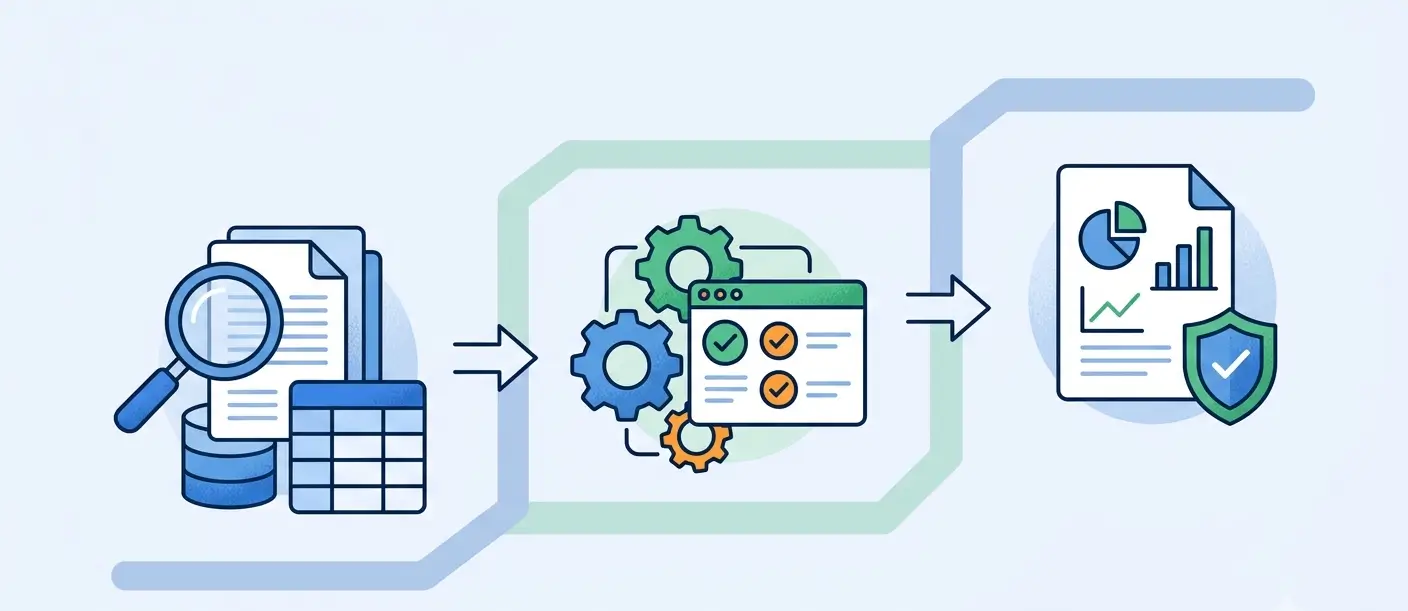
Research used to mean spending endless hours clicking through websites, scrolling through heavy reports, cross-checking details, and scribbling down notes. Today, AI takes care of that heavy lifting. In just a few seconds, it can scan through massive files, summarize the most important points, keep your research organized, and help you get clear answers to big questions much faster.
However, speed does not always mean accuracy. An AI system can produce a convincing answer that contains incorrect information. It may also misunderstand a source or provide a citation that does not support its claim. The biggest change is how people now organize the research process. Researchers can divide the work into smaller tasks, check sources, test results, and review important findings before using them.
What Are AI Research Workflows?
An AI research workflow is a series of steps that uses artificial intelligence to support research. These steps may include finding information, reading documents, comparing evidence, summarizing findings, and preparing a report.
Imagine a small business owner trying to figure out why customers leave items in their cart without buying. Instead of spending hours reading through customer feedback and website analytics one by one, they can let AI sort through the data for them. The AI quickly pulls out key details, organizes customer comments, highlights website drop-off points, and flags the main reasons people leave—giving the owner clear insights without all the hassle.
The owner would still need to check the original data before deciding what to change. AI helps organize the work, but the person remains responsible for the final decision.
How a Research Workflow Works
A typical AI research workflow follows these steps:
- Define the question: Decide exactly what you need to learn.
- Collect information: Find relevant reports, articles, documents, or data.
- Review the evidence: Check whether the information answers the question.
- Organize the findings: Group related facts and compare different viewpoints.
- Verify important claims: Open sources and confirm the details.
- Prepare the final report: Present the findings with clear explanations and supporting evidence.
This simple routine keeps researchers from just grabbing the first answer without seeing how the AI actually built it.
Why AI Research Workflows Are Becoming More Reliable
AI research is improving because researchers can combine automated assistance with clearer rules and stronger checking methods. Several changes help make this process more dependable.
1. AI Can Work With Specific Sources
One important improvement is the ability to connect AI systems with selected documents and information sources. Instead of relying only on information learned during training, some systems can search a collection of documents and use relevant passages to answer a question. This approach is often called retrieval-augmented generation, or RAG. In simple terms, the system looks for relevant information and uses it to prepare an answer.
For example, an employee researching a company’s vacation policy could use a system connected to the employee handbook. The answer can draw from the actual policy rather than relying on a general guess about workplace rules.
2. Source Verification Is Becoming a Bigger Priority
A research report becomes useful only when readers can check its important claims. This is why source verification plays such an important role in reliable AI research. A citation should lead to a real source. The source should also support the statement attached to it. A link that opens a genuine report is not enough if the report says something different from the claim.
Researchers can improve source verification by checking:
- The original source: Open the report, study, or official page instead of relying only on a summary.
- The publication date: Confirm that the information is current enough for the research question.
- The supporting passage: Make sure the cited section contains evidence for the claim.
- The source’s credibility: Consider who published the information and what evidence they provide.
These checks matter when researching business trends, public policies, health information, and financial topics. Even a well-written summary can create problems if it relies on weak or outdated evidence.
3. Research Tasks Are Becoming More Structured
Asking an AI system to research a broad topic and write a complete report in one step can make errors harder to notice. A better approach divides the task into smaller stages. For example, a researcher studying the U.S. electric vehicle market might first identify the research questions. The next step could involve collecting government statistics, reviewing industry reports, and comparing the findings. Only after those steps should the researcher prepare a summary.
Each stage has a clear purpose and a result that someone can review. If the final report contains a questionable number, the researcher can return to the relevant source rather than starting the entire process again. This structure also makes it easier to repeat the research later. A team can follow the same steps when new information becomes available.
4. Testing Helps Reveal Weaknesses
Reliable research systems need more than good answers to a few sample questions. Researchers also need to test how the system performs across different tasks.
For example, a research assistant might answer common questions correctly but struggle when two reports disagree. It might also overlook an important qualification or confuse an estimate with a confirmed figure.
Testing can reveal these problems before people depend on the system for important work. NIST supports the evaluation of AI systems through its AI Risk Management Framework. These resources help organizations consider risks, testing, and trustworthiness throughout an AI system’s lifecycle.
5. Human Review Remains Part of the Process
Automation can reduce repetitive work, but it does not remove the need for human judgment. Imagine that an AI research assistant finds three reports about a company’s revenue. One report covers the calendar year, another covers a fiscal year, and the third provides a forecast. If the researcher compares these figures without checking their time periods, the final conclusion may be misleading.
A human eye catches things AI misses—like heading back to the original source to make sure every figure is accurate. That human double-check matters most when big decisions are on the line, whether it involves health, money, law, hiring, or safety. In those areas, getting the facts wrong can do real damage.
How Reliable AI Research Helps Different Industries
AI research workflows can support many types of work. Their value depends on the quality of the information and the checks built into the process.
1. Business and Market Research
Business teams can use AI to organize competitor information, summarize customer feedback, and compare industry reports. This can help employees identify questions that deserve closer attention. However, teams should verify market figures and confirm that reports cover comparable periods. A competitor’s advertised price, for example, may not include shipping, discounts, or additional fees.
2. Academic Research
Students and researchers can use AI to organize reading notes, summarize papers, and identify connections between studies. These tasks can save time when a project involves many documents. They should still read the original papers before citing them. A summary may leave out important limits, and a study’s findings may not support a broad conclusion about every person or situation.
3. Healthcare and Scientific Research
AI can help researchers sort scientific publications and identify relevant findings. This may help them review large amounts of information more efficiently. However, researchers must examine study methods, sample sizes, limitations, and conflicts between results. They should never treat an AI-generated explanation as a substitute for proper scientific review.
4. Journalism and Content Research
Writers can use AI to create research outlines, locate useful background material, and organize information from multiple sources. This can make the early stages of an article easier. Before publication, writers should confirm names, dates, statistics, quotations, and important claims. They should also distinguish established facts from opinions, predictions, and claims that remain uncertain.
Common Problems That Still Affect AI Research
AI research workflows have improved, but several problems remain.
- Incorrect information: AI tools can write so confidently that incorrect information sounds completely real. That is why researchers need to double-check key facts rather than trusting a polished, convincing tone.
- Weak or outdated sources: An AI system might pull up details that do not actually answer your question or are simply outdated. That is why researchers should always check when a source was published and rely on reliable, original sources whenever possible.
- Missing context: A simple summary can easily miss important limits or make a specific finding sound like a broad rule. Taking a quick look at the original source helps you avoid this trap and catch the full picture.
- Conflicting evidence: Two credible sources may reach different conclusions because they use different methods or study different periods. Researchers should explain the disagreement rather than automatically choosing the answer that sounds most convincing.
- Privacy concerns: Research deals with private business data, personal details, or unpublished findings. Teams should always stick to their company’s data rules and avoid typing sensitive information into unapproved AI tools.
Conclusion
AI research workflows are becoming more reliable because researchers are moving toward structured tasks, stronger source verification, regular testing, and human review. These methods make it easier to catch errors before they enter a report or influence a decision. While AI makes it easy to search faster, organize data, and read through massive files, fast answers mean very little without solid proof. True reliability comes down to whether the evidence actually backs up the conclusions. By pairing smart tools with human judgment, research becomes far easier to verify, replicate, and trust.
