


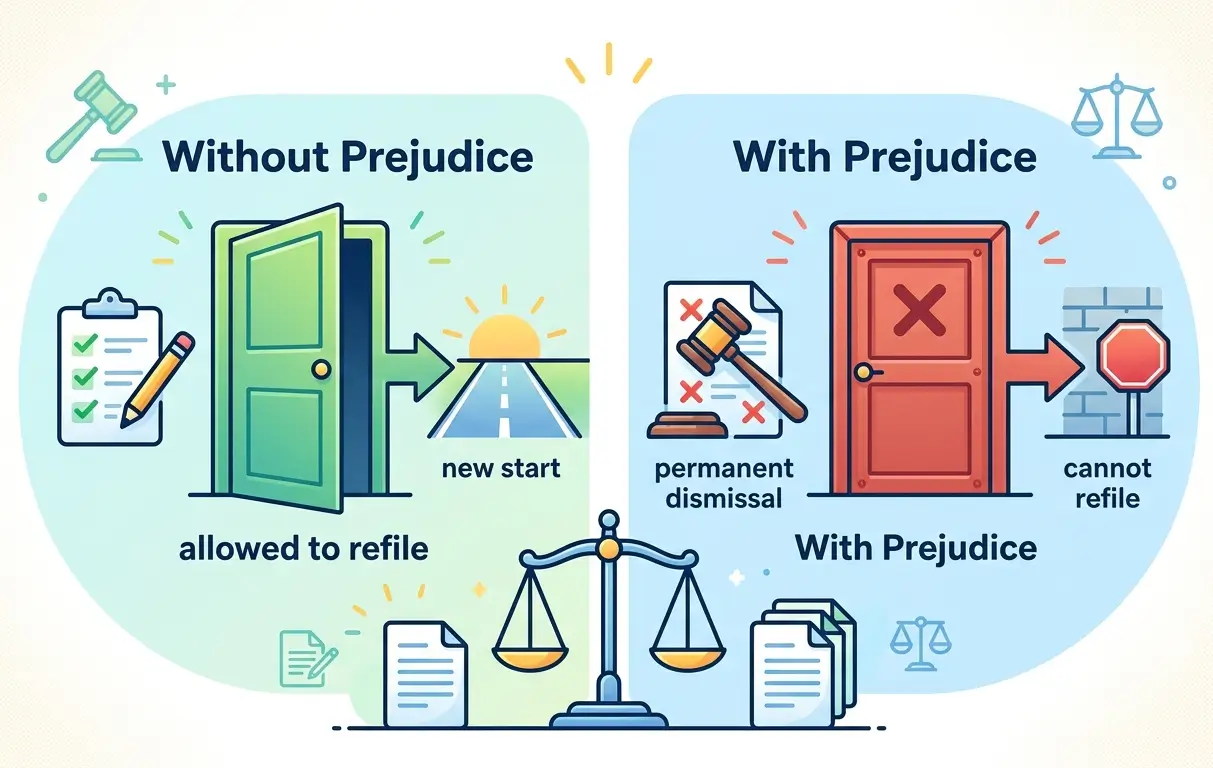
A court’s decision to dismiss a lawsuit may have an impact on subsequent events. The person who initially filed the case might be able to do so in some circumstances. Others may not be able to pursue the same claim in the future due to the dismissal. This is where the terms dismissed with prejudice and dismissed without prejudice become important. Both terms describe how a court ends a case or claim, but they do not have the same meaning. Understanding the difference can help you make sense of court notices, legal documents, and the options available after a dismissal.
What Does Dismissed With Prejudice Mean?
A case dismissed with prejudice generally means the court has ended the claim in a way that prevents the person from bringing the same claim again. The dismissal usually carries a final legal effect. Imagine that you file a lawsuit against a contractor for failing to finish a home remodelling. Once the court has made a final ruling on the legal concerns, it rejects your claim with prejudice. Generally speaking, you can’t bring the same claim against the same contractor in a different lawsuit.
This does not mean you can never take legal action against that person for any reason. A separate claim based on a different event or legal issue may receive different treatment. The exact effect depends on the court’s order and applicable law. The legal concept that often prevents someone from bringing the same claim again is called res judicata, which helps prevent repeated lawsuits over matters that have already been decided.
Why Would a Court Dismiss a Case With Prejudice?
A court may dismiss a case with prejudice for several reasons, depending on the circumstances and applicable rules.
- A final decision on the claim: The court has resolved the relevant legal issues and will not allow the same claim to be brought again.
- Repeated failure to follow court rules: A court may impose dismissal as a sanction in appropriate circumstances.
- Failure to correct legal problems: A court may determine that a claim cannot proceed and dismiss it with prejudice, depending on the issue and applicable law.
- A settlement agreement: Parties may agree to dismiss a lawsuit with prejudice as part of a settlement, subject to the required court procedures.
A dismissal with prejudice can have serious consequences. If you receive an order using this language, read the entire document rather than relying on the phrase alone.
What Does Dismissed Without Prejudice Mean?
A case dismissed without prejudice generally means the court has ended the current case without preventing the person from filing the claim again. In simple terms, the case has ended for now, but the person may still have another opportunity to pursue it.
For example, imagine you file a lawsuit against a business, but you file it in a court that lacks the authority to hear that type of dispute. The court may dismiss the case without prejudice. You may be able to file it in the correct court if you meet the relevant legal requirements.
However, without prejudice does not guarantee that you can successfully file the case again. You must still follow filing rules, meet deadlines, and satisfy other legal requirements.
Why Would a Court Dismiss a Case Without Prejudice?
Common situations may include:
- The wrong court: The court lacks jurisdiction, or the case belongs in another court.
- A correctable filing problem: The paperwork or legal process contains an issue that the rules allow the person to correct.
- Voluntary dismissal: The person who filed the case chooses to withdraw it under the applicable rules.
- Other procedural reasons: The court ends the current case without deciding that the underlying claim must be barred forever.
The reason for dismissal matters. Sometimes the person can fix the problem and file again. In other situations, a deadline or another legal restriction may prevent a new filing.
Dismissed With Prejudice vs. Without Prejudice: Key Differences
The main difference is whether the dismissal generally prevents the same claim from being filed again.
| Point of comparison | With prejudice | Without prejudice |
| Meaning | Generally ends the claim permanently | Ends the current case without necessarily barring another filing |
| Can you file the same claim again? | Generally no | Potentially yes |
| Final effect | Usually final as to the claim | May leave another legal option open |
| Can you fix a filing problem? | Usually not by simply filing the same claim again | Sometimes, depending on the problem |
| Deadline concerns | Other legal options may still have strict deadlines | Filing again may still be subject to deadlines |
| Common concern | Losing the ability to pursue the same claim | Missing the chance to refile within the permitted time |
These are general principles, not guarantees. The actual effect depends on the type of case, the court’s order, and the law that applies.
Can You Refile a Case Dismissed Without Prejudice?
Yes, you may be able to refile a case dismissed without prejudice. However, you should check a few important points before taking action.
1. Check the Filing Deadline
Every legal claim has rules about how long a person has to bring it. These limits are often called statutes of limitations. For example, suppose you file a civil claim near the end of the applicable filing period. The court dismisses it without prejudice because of a procedural problem. You should not assume that you automatically receive a fresh deadline. Depending on the law, the original deadline may continue to apply. Some jurisdictions have special rules that may give you additional time, but those rules do not apply to every case.
2. Understand Why the Court Dismissed the Case
Read the dismissal order carefully. It may explain whether you need to correct paperwork, use a different court, or take another step before filing again. If the court identified a problem with your original filing, simply submitting the same documents again may not solve it.
3. Check Whether the Court Set Any Conditions
Some dismissals come with conditions, such as requirements related to costs or other court procedures. Review the order and any settlement agreement before filing a new case.
4. Get Legal Advice When Necessary
If the claim involves a large amount of money, an injury, a business dispute, or an approaching deadline, a qualified attorney can help you understand your options. The most important step is to act promptly. Waiting too long may affect your legal rights even when the court dismissed the original case without prejudice.
Can You Reopen a Case Dismissed With Prejudice?
A dismissal with prejudice is generally intended to be final, but that does not mean every possible legal option disappears. Depending on the circumstances, a person may be able to challenge the decision through an appeal or ask the court to set it aside under applicable rules. These options have specific requirements and strict deadlines.
For example, suppose a judge dismisses your case with prejudice, but you believe the judge made a legal error. You may have grounds to appeal, depending on the circumstances. An appeal is different from filing the same lawsuit again.
Do not assume that the court will reopen the case simply because you disagree with the decision. You should review the order and promptly ask an attorney whether a legal remedy remains available.
Real-Life Examples of Both Types of Dismissal
These examples show how the two terms can affect an ordinary person.
Example 1: A Car Accident Claim
Suppose you file a lawsuit against another driver after a car accident. The court dismisses the case without prejudice because of a procedural problem that you may be able to correct. You might be able to file again if you correct the issue and meet all applicable deadlines. Now imagine the court dismisses the same claim with prejudice after a final decision. You generally cannot bring the same claim again simply by changing the paperwork.
Example 2: A Business Payment Dispute
A small business owner sues a customer who has not paid an invoice. If the court dismisses the case without prejudice because the owner filed in the wrong court, the owner may be able to bring the claim in the proper court. If the court dismisses the claim with prejudice, the owner may be barred from pursuing that same claim again. The precise result depends on the court’s order and the applicable law.
What Should You Do After Receiving a Dismissal Order?
If a court has dismissed your case, take these practical steps:
- Read the complete order: Find out whether the dismissal is with prejudice or without prejudice.
- Identify the reason: Check whether the court dismissed the case because of a procedural issue, a legal problem, or a final decision.
- Check the deadlines: Look for applicable filing limits and any deadlines for appealing or requesting relief.
- Keep your documents: Save the dismissal order, court filings, settlement agreements, and related correspondence.
- Speak with an attorney: Legal advice is especially important when you face a deadline or the dismissal could prevent you from recovering money.
For additional information, consult the U.S. Courts glossary of legal terms and Federal Rule of Civil Procedure 41. These resources explain dismissal terminology and the rules governing dismissal of civil actions in federal court. State courts may follow different procedures.
Conclusion
You can determine the implications of a court’s ruling for your further actions by understanding dismissed with prejudice vs dismissed without prejudice. While a dismissal without prejudice may let you refile provided you satisfy the relevant legal standards, a dismissal with prejudice usually prohibits you from bringing the same claim again. Don’t depend just on the label if you obtain a dismissal order. Check any deadlines that relate to your case, read the entire order, and comprehend the rationale for dismissal. An attorney can assist you in choosing the safest course of action when your financial or legal rights are at risk.