


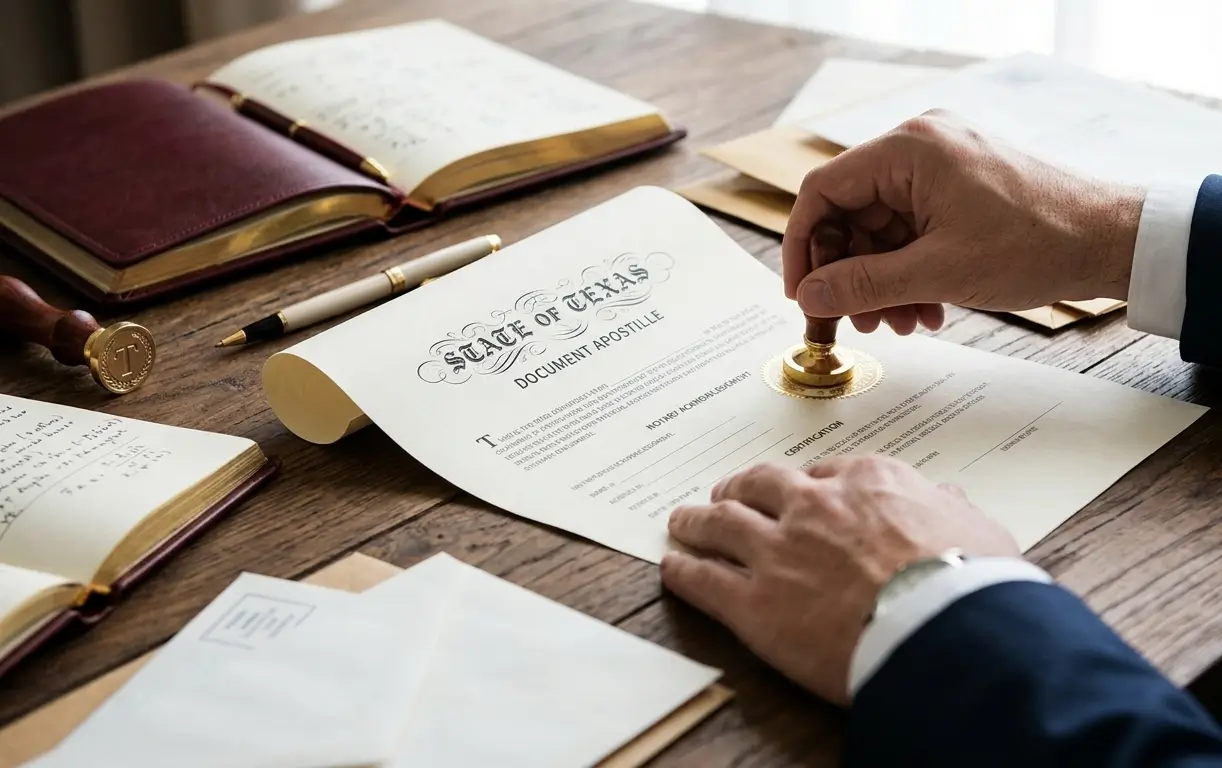
If you are planning to use a Texas document in a foreign country, you might need an apostille. This certificate can be utilised by foreign authorities to confirm the origin of some public documents. Perhaps you need one to get a birth certificate, marriage certificate, graduation certificate, power of attorney, or a business document. For example, someone moving from Texas to another country for work may need an apostille for a college diploma. A couple getting married abroad may need an apostille for a Texas marriage certificate. The exact requirements depend on the document and the country where you plan to use it.
Preparing your paperwork correctly can save you time, money, and repeat trips to government offices. The good news is that the process becomes easier when you know which documents need certification, when notarization is necessary, and where to submit your application.
What Is an Apostille?
An apostille is an official certificate that authenticates the origin of a public document to be used in another country that is a party to the Hague Apostille Convention.
It helps the receiving country confirm details such as the signature, the capacity in which the person signed the document, and the seal or stamp, when applicable. It does not confirm that every statement in the document is true. The apostille process follows rules established under the Hague Convention of 5 October 1961.
When Do You Need a Texas Apostille?
You may need an apostille if a foreign government, university, employer, court, or other organization asks you to provide an officially authenticated Texas document.
Common examples include:
- Birth and marriage certificates used for immigration or family matters.
- College diplomas and academic records used for overseas education or employment.
- Powers of attorney and affidavits prepared in Texas.
- Business records required for international company registration.
- Court documents needed for certain legal matters abroad.
Always review the instructions provided by the receiving organisation. Certain nations or organisations demand extra paperwork, certified translations, or an alternative method of authentication.
Step 1: Confirm Which Authority Issued Your Document
Your first task is to identify the document’s issuing authority. Not every Texas document follows the same preparation process. For example, a Texas birth certificate is different from a letter signed by a private individual. A government-issued vital record may need official certification, while a private document may require notarization before it can qualify for an apostille.
Documents Issued by Texas Government Offices
If you need an apostille for a birth certificate, marriage certificate, or another official record, first confirm that you have an acceptable certified copy. A regular photocopy or an informal printout may not meet the requirements. Some records must come directly from the appropriate government office or carry the correct official certification.
For Texas vital records, check the requirements of the Texas Department of State Health Services. This is a useful starting point for understanding how to obtain eligible birth, death, and marriage records.
Documents Signed by Private Individuals
Documents such as affidavits, powers of attorney, and certain declarations may require notarization. A notary public verifies the signature or performs another authorized notarial act. The notary does not automatically confirm that every statement in the document is accurate. Before signing, check whether the receiving country requires a particular notarial certificate or specific wording. If notarization is necessary, follow the applicable Texas rules.
Step 2: Check Whether You Need a Certified Copy or Notarization
One of the most common mistakes is assuming that every document needs notarization. That is not always true.
The correct preparation depends on the document type.
| Document type | What to check before applying |
| Birth certificate | Whether an eligible certified copy is required |
| Marriage certificate | Whether the copy meets Texas authentication requirements |
| College diploma | Whether the institution or receiving country requires notarization or another certification |
| Power of attorney | Whether the document must be properly notarized |
| Affidavit | Whether the signature and notarial certificate meet the applicable requirements |
| Business document | Whether the document needs notarization or certification by an authorized office |
This table provides general guidance, not a guarantee that a particular document qualifies. Confirm the current requirements with the Texas Secretary of State before submitting your paperwork.
Why Document Type Matters
An apostille office verifies the official origin of a document or the relevant signature, seal, or stamp. It does not turn an otherwise unacceptable photocopy into an acceptable public record. For example, if a foreign university asks for an apostille on your diploma, sending a simple photocopy without checking the university’s instructions could cause delays. The university may require a notarized copy, a document issued by the school, or another form of verification. Ask the receiving organization what it will accept before paying for notarization or ordering certified copies.
Step 3: Prepare the Document Carefully
Once you know the requirements, inspect the document before submitting it. The paper should be complete and easy to read. For important information, make sure you can see the names, dates, signatures, seals, and other details. Check that you have included all the necessary pages and attachments if the document has more than one page.
Do not make unauthorized changes to an official record. If you find an error in a birth certificate, marriage certificate, or other government record, contact the issuing office to learn how to correct it.
If Your Document Needs Notarization
Follow these basic precautions:
- Wait to sign if required: Some notarial acts require you to sign in the notary’s presence.
- Bring acceptable identification: Ask the notary which identification documents they accept.
- Check the notarial certificate: Make sure the certificate is complete and contains the required information.
- Review every page: Confirm that the correct document was signed and that any required attachments are present.
Notarization requirements can differ according to the type of document and notarial act. Do not assume that a stamp alone makes a document eligible for an apostille.
What About Documents in Another Language?
If your document is in a language other than English, check the receiving country’s requirements before arranging a translation. Some authorities require a certified translation, while others may ask for the original document and a separate translation. An apostille generally verifies the origin of the underlying public document or qualifying notarial act; it does not certify the accuracy of a translation unless a separate process applies.
Step 4: Complete the Texas Apostille Application
Once you’re done making your document, look over the latest instructions from the Texas Secretary of State. For documents that are valid in Texas, the office handles apostille and authentication services. Visit its website to get the most up-to-date application form, instructions on how to submit it, fee schedule, and information on how to handle your application.
Before sending your application, check that you have:
- The original or qualifying certified document, as required.
- Any necessary notarization or supporting certification.
- The completed application form.
- The required payment.
- A return envelope or shipping arrangement, if required by the submission method.
Read the instructions carefully. Requirements can change, and an older application form or outdated fee information may cause avoidable delays.
Check the Destination Country
An apostille is typically used for documents meant for nations that sign the Hague Apostille Convention and apply it to the appropriate relationship. If the destination country does not accept apostilles for your situation, you may need a different authentication or legalization process. Check the receiving country’s official instructions before mailing your documents.
Step 5: Submit Your Documents Through the Correct Channel
Once your documentation is complete, follow the Texas Secretary of State’s current submission requirements. Depending on the service and document, the procedure and requirements may vary. Make sure you pick a reputable shipping provider and save a duplicate of your application as well as the tracking information if you choose to send in your documents through the mail.
In the event that the office allows for an alternative mode of filing for your circumstances, it is important to verify the prerequisites before making the trip. Do not send your only copy of an important personal document unless the official instructions require it. When possible, keep a separate copy for your records.
How Long Does a Texas Apostille Take?
Processing times depend on the office’s workload, the submission method, and whether your paperwork is complete. Shipping can add more time to the overall process.
If you have a university deadline, overseas job start date, visa appointment, or international business filing, begin early. Check the official processing estimate before making travel or submission plans. Avoid relying on an unverified promise of same-day or guaranteed service.
Step 6: Review the Apostille Before Using It
When you receive your apostille, check that the certificate is attached to or associated with the correct document according to the applicable procedure. Review the names and other identifying details. Make sure the certificate has not become separated from the document and that you have all pages returned by the office.
If you notice a possible error or missing page, contact the issuing authority before submitting the paperwork overseas. Also, ask the receiving organization whether it needs the original apostilled document, a certified copy, a translation, or any additional paperwork. Keep in mind that an apostille does not guarantee acceptance for every purpose. The receiving authority makes that decision under its own rules.
Avoid Mistakes When Getting Texas Documents for an Apostille
Even a small preparation mistake can lead to extra expenses or delays. Watch out for these common problems:
1. Sending an Ordinary Photocopy
A photocopy may not meet the requirements for a government-issued record. Confirm whether you need an original, certified copy, or notarized document.
2. Not Checking the Destination Country’s Rules
The document requirements for immigration may differ from those for education, marriage, or business registration. Ask the receiving organization for its exact instructions.
3. Using an Incomplete Notarial Certificate
Missing details or an incorrect notarial act can prevent a document from qualifying. Review the certificate before submitting it.
4. Relying on Old Forms or Fees
Application forms, fees, and processing instructions can change. Always consult the current Texas Secretary of State guidance.
5. Waiting Until the Last Minute
The full process may include obtaining a certified copy, arranging notarization, submitting the application, and waiting for delivery. Allow enough time for every stage.
Conclusion
Following the right procedures makes getting Texas documents ready for an apostille considerably simpler. First, find out what the recipient nation or organisation needs. Next, determine the issuing authority, acquire the appropriate document, set up any required certification or notarization, and adhere to the most recent Texas Secretary of State application guidelines.
Most importantly, do not assume that every document follows the same process. A birth certificate, diploma, affidavit, and power of attorney can have different requirements. Check official guidance before paying fees or mailing important paperwork. A little preparation can help you avoid common mistakes and get your Texas documents ready for international use with less stress.